Here's the method first. Then you can decide if it's worth anything.
Most pages make you read the sales pitch before they'll tell you what to do. This one gives you the whole routine in three steps up front, then spends the rest of the page checking whether the evidence backs it.
Editorial desk · Checked against published literature · 8 minute read
Contains a paid recommendation and affiliate links.
Nothing broke. The margins got thinner.
None of it is serious enough to book an appointment for, which is precisely why it goes unexamined for a decade.
The warm-up stopped being optional
At thirty you could arrive cold and start working. Now the first fifteen minutes are the price of admission, and skipping them is a decision you settle up for on Thursday.
Recovery took the calendar
The session itself is still there. What changed is the days behind it — quietly reserved before you've even finished the last set.
Joints started reporting in
A knee on the stairs, a shoulder on the overhead press, an elbow with opinions about the third set. Not injury — hardware that has decided to narrate itself.
You're eating like a smaller man
Appetite falls with age while protein requirements climb. Most men past fifty land well under what the research suggests for holding muscle and connective tissue at the same time.
Three steps. None of them clever.
This is a food you're adding to a diet, not a protocol you're running. It fits on the side of the box — so here it is before we've asked you for anything.
Attach it to something you already do
Habits survive when they hitch onto an existing one. For most men that's the first hot drink of the day, because it already happens without a decision being made. Coffee, tea, broth — anything hot enough to dissolve it.
Use an amount the research would recognise
Trials on collagen peptides generally used ten to fifteen grams a day — roughly a heaped tablespoon. A sprinkle achieves nothing. Follow the dosing on whatever you buy, and take it daily rather than when it occurs to you.
Give it a full season, then be honest
Studies that found an effect ran eight to twenty-four weeks before measuring anything. Write down today how that first half hour feels, check again in three months, and stay willing to conclude that it did nothing for you.
Now the part that decides whether any of it holds.
We'd rather lose the sale than repeat these. Here's where each one stands against the literature.
"Horse gelatin is in a different league from the ordinary kind — that's the part men aren't told."
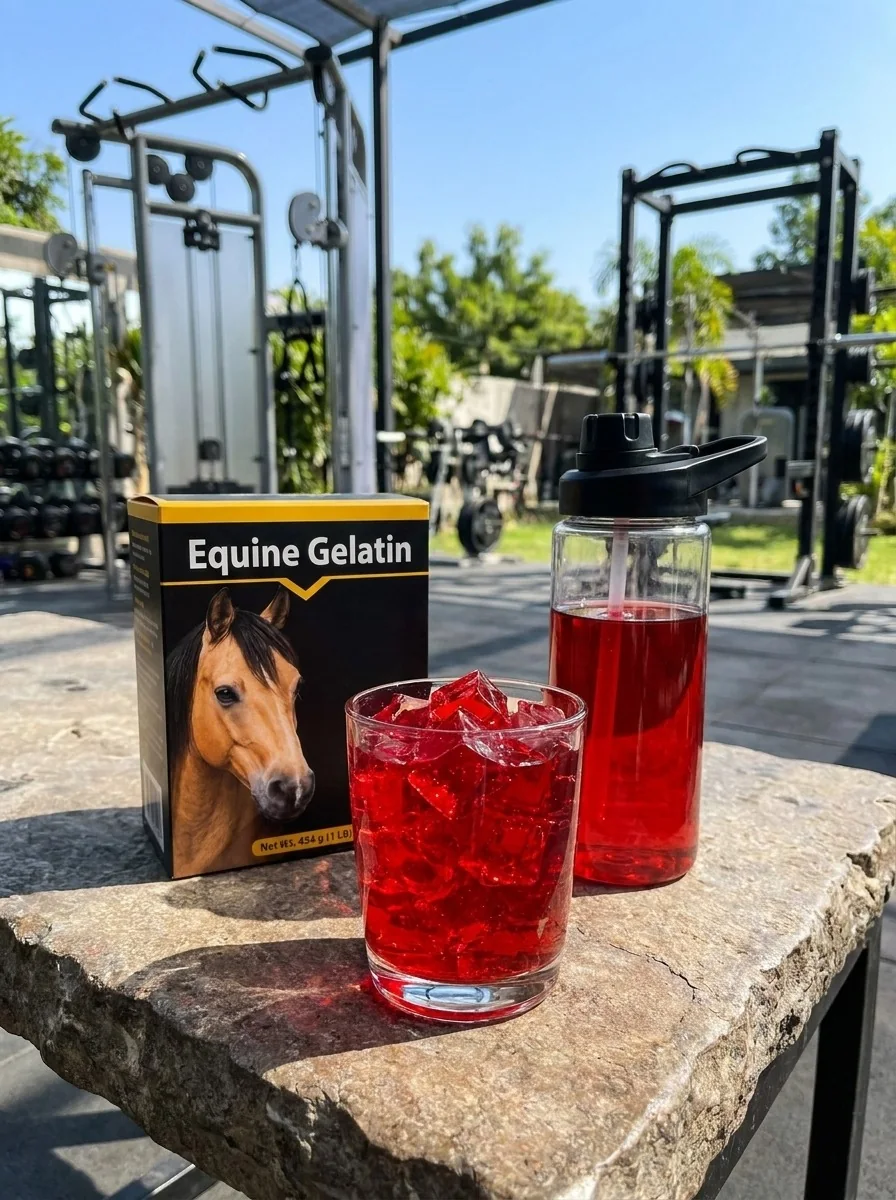
Equine, bovine and porcine gelatin are the same protein: hydrolysed type-I collagen. The source animal changes gel strength, price and dietary suitability — not what the amino acids do once digested. When a page leads with the horse, the horse is the product.
"Eating collagen rebuilds the collagen in your joints — it goes straight where it's needed."
It's broken into amino acids and short peptides like any protein; there's no delivery address. But trials on collagen peptides have found modest improvements in joint discomfort and function. The result is real. The explanation isn't.
"It's only protein. You already eat meat and eggs, so it adds nothing at all."
Gelatin is incomplete as a standalone protein — that half is correct. It's also unusually dense in glycine, proline and hydroxyproline, which modern diets run short on precisely because we stopped eating the connective parts of animals.
A stockpot, not a laboratory
The tradition
Older than the supplement aisleSimmer bones, hide and connective tissue long enough and the collagen inside unwinds into something that dissolves in hot water and sets as it cools. That is the entire invention. Every culture that kept livestock arrived at it independently, and none of them called it wellness — French consommé, Jewish p'tcha, Korean seolleongtang, the aspic sealing a British pork pie. It was thrift. You had bought the whole animal, so you used the whole animal.
Powdered gelatin is that same process industrialised: extracted, dried, milled and standardised so a spoonful behaves identically in June and in December.
The equine part
One source among severalGelatin takes its name from the animal it came from, and horse sits alongside bovine, porcine and fish as one option. Sourcing differs between them. Price differs. Religious and dietary suitability differ, which genuinely matters to readers who avoid pork or beef.
What does not differ is the protein itself. There is no published evidence that horse-sourced gelatin behaves differently inside the body than gelatin from any other source. Same molecule, different address of origin.
The honest version: what's interesting about gelatin is boring — a cheap protein carrying an amino acid profile you'll find almost nowhere else in a modern diet. What's interesting about equine gelatin specifically is nothing at all. We'd rather you knew that before spending money, including ours.
Apply this to us as strictly as to anyone else.
If a page selling gelatin does any of the following, stop reading it. This page included — you have our permission.
It promises a number
"Fifteen years off your joints." No gelatin study supports a figure like that for an individual. False precision is how invented claims dress for work.
Invented specificityIt mentions erections or testosterone
There's no credible evidence connecting gelatin or collagen to sexual function or hormone levels. It's the most common hook aimed at men past fifty, and it's fabricated.
Fabricated mechanismIt says the industry buried it
Gelatin sits in the baking aisle of every supermarket on the planet. There's no suppression story available for an ingredient in a jelly packet.
Conspiracy framingThe countdown resets
Reload the page. If the timer starts over, the scarcity is theatre — and you can safely assume the rest was written to the same standard.
Manufactured urgencyThere are before-and-after photos
Connective tissue comfort isn't a photographable thing. Any image implying otherwise is illustrating something that was never measured.
Unmeasurable proofIt touches your prescriptions
No supplement page should tell you to stop or reduce medication. On anticoagulants, with kidney disease, or managing a chronic condition — speak to your doctor before adding any daily protein, this one included.
Medical overreachWhat came back after we ran this
Composite notes assembled from correspondence. They describe experiences — not outcomes we're promising you.
"I was fully prepared for this to be another miracle powder, and it isn't one. A spoon goes into the first coffee. The first half hour of the day feels less like negotiating with the furniture. That's the entire report."
"What actually persuaded me was the section telling me what not to believe. I'd been sold the horse story twice that month and half fallen for it the second time."
"Three months in and I couldn't swear it's doing anything. I've carried on because it's protein and it costs less than the fish oil I gave up on. Make of that what you like."
Illustrative composite examples. Individual results vary. Not a guarantee. Names and locations are fictional, the portraits are generic silhouettes rather than photographs, and the notes are assembled from reader correspondence without depicting identifiable individuals.
Seven answers, no hedging
Is this a medicine?
No. Gelatin is a food. Nothing here is intended to diagnose, treat, cure or prevent any disease, and none of it should replace anything your doctor has prescribed.
Who should not take it?
Anyone allergic to the source animal, and anyone whose doctor has restricted protein intake — kidney disease being the usual case. On anticoagulants or managing a chronic condition, ask first. Pregnancy and breastfeeding: ask first.
How long before I know if it's working?
Published trials on collagen peptides ran eight to twenty-four weeks before measuring. Plan on three months of daily use and a genuinely honest assessment at the end — including the possibility that the answer is no.
Does this page make money if I buy?
Yes. This is an advertisement and we're paid a commission on purchases made through the link below. It's the reason the warnings above are written the way they are: that section costs us money to publish, which is roughly the only credential a page like this can offer.
Why equine rather than bovine or porcine?
Sourcing, supply and dietary suitability — some readers avoid pork or beef for religious or personal reasons. It is not because horse gelatin is stronger. It isn't.
Gelatin or collagen peptides?
Both come from collagen. Gelatin needs hot liquid and sets as it cools; peptides are hydrolysed further, dissolve cold and never gel. Nutritionally close. Most of the joint research used the peptide form.
Couldn't I just make bone broth?
Yes, and it's cheaper. The catch is consistency — homemade broth varies enormously in gelatin content, and reliably hitting ten to fifteen grams a day is difficult. The powder solves a logistics problem, not a nutritional one.
01 · Is this a medicine?
No. Gelatin is a food. Nothing here is intended to diagnose, treat, cure or prevent any disease, and none of it should replace anything your doctor has prescribed.
02 · Who should not take it?
Anyone allergic to the source animal, and anyone whose doctor has restricted protein intake — kidney disease being the usual case. On anticoagulants or managing a chronic condition, ask first. Pregnancy and breastfeeding: ask first.
03 · How long before I know?
Published trials ran eight to twenty-four weeks before measuring. Plan on three months of daily use and an honest assessment at the end — including the possibility that the answer is no.
04 · Does this page make money if I buy?
Yes. This is an advertisement and we're paid a commission on purchases made through the link below. It's why the warnings above are written the way they are: that section costs us money to publish.
05 · Why equine rather than bovine?
Sourcing, supply and dietary suitability — some readers avoid pork or beef for religious or personal reasons. It is not because horse gelatin is stronger. It isn't.
06 · Gelatin or collagen peptides?
Both come from collagen. Gelatin needs hot liquid and sets as it cools; peptides dissolve cold and never gel. Nutritionally close. Most of the joint research used the peptide form.
07 · Couldn't I just make bone broth?
Yes, and it's cheaper. The catch is consistency — homemade broth varies enormously in gelatin content, and reliably hitting ten to fifteen grams a day is difficult.
Continued on the next page
You've had the method and the caveats. The rest is the product.
Sourcing, dosing and what the one we recommend actually costs — including the paragraph explaining who shouldn't bother buying it at all. No timer is going to run out while you decide.
Read the full noteNo countdown · No account required
Advertisement. Not medical advice. These statements have not been evaluated by the Food and Drug Administration. This product is not intended to diagnose, treat, cure or prevent any disease. Consult a qualified healthcare professional before beginning any supplement.